Thursday, November 6, 2008
Price Check!
Sunday, November 2, 2008
Potato Tower Yield LOW!
How many potatoes do you count in this photo? If you counted 12, you are correct.
...but that moment never came! IT NEVER CAME!
I was actually so sure of my future success that over the past few weeks I have been researching potato storage methods, new recipes, etc. Why did I do this? Because I knew that no ordinary human could actually consume the number of potatoes I created.
I just don't know!
Thursday, October 30, 2008
Cooler days perfect for planting garlic
Wednesday, October 29, 2008
Crazy Veggies
I had posted an interesting image about a square watermelon when I was first getting going with this blog. I always thought it would be an interesting project, and then I found some other weird/crazy ideas from looking at my RSS feeds.


Who I accessed through Neatorama. http://www.neatorama.com/Wednesday, October 15, 2008
Heirloom Tomatoes
Aren’t these tomatoes beautiful? They are from the garden in NY. I often hear gardeners speak about heirlooms, I wanted to know more about what this term means. Here is a summary of what I found on Wikipedia:
This definition is highly debated, but it can be broken down into two main schools of thought:
1. To be an heirloom, the seeds must be a certain age (over 100 years old, 50 years, or around 1945 which marks the beginning of industrial agriculture and hybrid seeds.)
2. A true heirloom is a cultivar that has been nurtured, selected, and handed down from one family member to another for many generations. This also includes cultivars that were picked up by companies.
However, regardless of definition specifics, most agree that heirlooms must be open pollinated (pollinated by bees, animals, wind) using natural breeding practices, which means no GMOs can ever be considered an heirloom.
(Note: In this photo, you can find Green Zebras which seem to have a little controversy around them as well. According to some sources, they are not considered heirlooms.)
Wednesday, July 30, 2008
Got Mildew? Get Milk!
Gardeners are supposed to mound the soil for their squash plants to avoid this, but I wonder about how sun factors into all of this. I have also noticed that my squash plant that is in an area with less sun, but plenty of room, no irrigation, and a bit of insulation from the fence does not have this issue at all.
As a first resort, I have been cutting off the worst of the leaves, and surprisingly, new leaves and veggies have started to grow! I suspect that the mildew will continue to spread regardless of this small triumph, and I am only getting my hopes up for nothing. We will see.
So here is another method you can try: MILK!
http://www.pioneerthinking.com/tv-mildew.html
Got Mildew? Get Milk!
By: Arzeena Hamir
Less than 3 years ago, researchers in South America discovered a new alternative to controlling powdery mildew. Wagner Bettiol, a scientist from Brazil, found that weekly sprays of milk controlled powdery mildew in zucchini just as effectively as synthetic fungicides such as fenarimol or benomyl. Not only was milk found to be effective at controlling the disease, it also acted as a foliar fertilizer, boosting the plant's immune system.
Powdery mildew in the cucurbit family is caused by the organism Sphaerotheca fuliginea. It is a serious disease that occurs worldwide. For decades, organic gardeners had to rely on making a spray from baking soda to control the disease. Now, instead of measuring out the baking soda and combining it with a surfactant (a "sticking" substance) of either oil or soap, gardeners need only head for their refrigerators.In his experiments with zucchini plants, Bettiol found that a weekly spray of milk at a concentration of at least 10% (1 part milk to 9 parts water) significantly reduced the severity of powdery mildew infection on the plants by 90%. While some gardeners may be tempted to increase the concentration of milk for more control, Bettiol found that once concentrations rose above 30%, an innoccuous fungus began to grow on the plants.
How does milk control powdery mildew?
The benefits of using milk to control powdery mildew haven't been isolated to Brazil. Melon growers in New Zealand are saving thousands of dollars every year by spraying their crops with milk instead of synthetic fungicides. The melon growers in New Zealand have been so successful that the wine industry is taking notice and beginning experiments using milk to control powdery mildew in grapes.
Wagner Bettiol's original article was published in the journal Crop Science (Vol. 18, 1999, pp. 489-92). It can be found on-line at: http://147.46.94.112/journal/sej/full/c12_199908_180801.pdf
The Author© Copyright Arzeena HamirArzeena is an agronomist and garden writer with Organic Living Newsletter. Subscribe to this free e-newsletter at http://www.tvorganics.com/
Friday, July 25, 2008
Potato Tower Update
Here is the updated tower. As I said in the other post, I have not been able to add the higher levels fast enough, so the plants are drooping down and will be difficult to avoid breaking when I add the additional boards. This is my lessoned learned: stay one step ahead of the tower! The plants seem to grow (no joke) about six inches a day.
By the way, this is the product of only two small seed potatoes!
Wednesday, July 23, 2008
Nutritious Notes about Zucchini

I am getting a ton of zucchini right now in my garden. Here is some information for you:
Zucchini is low in calories, easily digested and high in vitamin A, potassium and iron. It is an excellent addition to a regular diet and beneficial for those taking medication for high blood pressure as it helps replace lost minerals. Even the blossoms may be eaten during the growing season, excellent in salads.
How to Harvest, Use and Store
Zucchini is best used fresh, as refrigeration reduces flavor. Although zucchini can grow to spectacular sizes the larger the fruit the less flavor. Zucchini skins become thick and tough and the meat spongy and tasteless with large seeds. Unless your end goal is buffet boats or edible veggie bowls it is best to pick them when they are 6 to 10 inches long, softball size for the eight ball variety. The very young fruits are picked with the blossoms still attached as fingerlings and are prized by gourmet gardeners.
Zucchini is one of the most versatile vegetables in the culinary arts. It can be used raw, steamed, grilled, fried, baked, stuffed, sautéed, pickled or preserved. It is easy to prepare , no peeling required, and can be frozen after minimal preparation for winter use.
(From The Fruit and Vegetable Stand by Barry Ballister, the Overlook Press, Peter Mayer Publishers, Inc., 2002--via the weblink: http://gocfa.org/gardens/2007-08-Newsletter.pdf)
Tuesday, July 22, 2008
potato power tower
Saturday, July 19, 2008
Millersport Corn Festival August 27-30th
When I was a little girl our family went to this festival every year. There is nothing better than sweet Ohio corn, salted and covered in butter. There's more than corn! Parades, beautiful Corn Queens, tractor pulls and I am intrigued by this one..."Outhouse Pulls", yikes! Check out their site and put it on your calendar. This would be a great festival to support our local farmers and have a fine time while you do it. I seem to forget about it every year---so this summer I am determined to not miss it!
Monday, June 30, 2008
Reduce, Reuse, and Grow
Wednesday, May 14, 2008
Friday, April 25, 2008
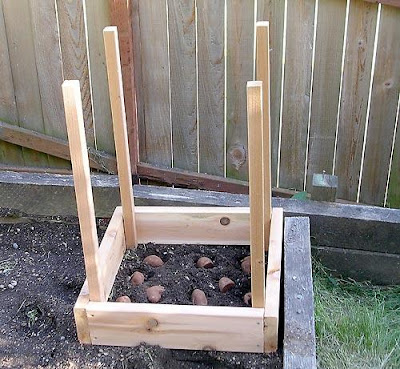
grow potatoes!
My friend Elaine and I were talking about growing potatoes and I did a little research:

The potatoes are planted inside the box, the first row of boards is installed and the dirt or mulch can now be added to cover the seed potatoes. As the plant grows, more boards and dirt will be added.
You can grow 100 pounds of potatoes in 4 square feet. All it takes is some lumber, seed potatoes and careful attention to watering.
"A lot of people think you plant a potato and that the new ones grow below it, but that's not so," Lutovsky said. "Potatoes grow between the seed piece and the above-ground plant."
Potato pointers/here are some growing tips from Greg Lutovsky:
- Cut apart larger seed potatoes, making sure there are at least two eyes in each piece you plant.
- Dust the cut pieces with fir dust, which seals the open ends from bacteria.
- Fertilize with 10-20-20 fertilizer at planting and a couple of times during the season.
- Water so that the plants are kept at an even level of moisture.
- Don't plant in the same area in consecutive years or use the same soil to fill your potato box, as potatoes can attract various diseases.
- When the plant blossoms, it starts setting potatoes in this added soil. Soon after that, you can start removing the bottom boards from your box and "robbing" the plant, reaching in carefully and pulling out new potatoes.
- Unless you steal all of them during the growing season, in the fall you should end up with a box of spuds — as much as 100 pounds
- Watering at an even rate is especially important when growing potatoes in a box since they will dry out faster in the container than in the ground.
- Don't drown and then let the potatoes dry out. Repeating that cycle throughout the year is a guarantee that you'll grow knobby, scabby potatoes
- Your full potato crop is ready to be harvested when frost kills the tops. Or, in the absence of frost, you can cut off the tops yourself, wait 10 days to two weeks for the skins to firm up and then take your box apart completely, sorting the potatoes from the soil.
Plan A Veggie Garden
http://www.chestnut-sw.com/growform.htm
Here is what a query for today's to-do list resulted in (it was in a handy table format, but I can't copy and paste into this!?):
Spring GrowGuide
Your Last Spring Frost Date: May 15
Your First Fall Frost Date: November 16? (I just guessed-does anyone know this for sure?)
Tasks calculated for week of April 24, 2008 (3 weeks before last spring frost)
sow indoors:
cucumbers, leaf lettuce, melons, pumpkins, summer squash, winter squash
sow outdoors:
beets, kale, kohlrabi, mustard greens, peas, potatoes, radishes, spinach, swiss chard, turnips